
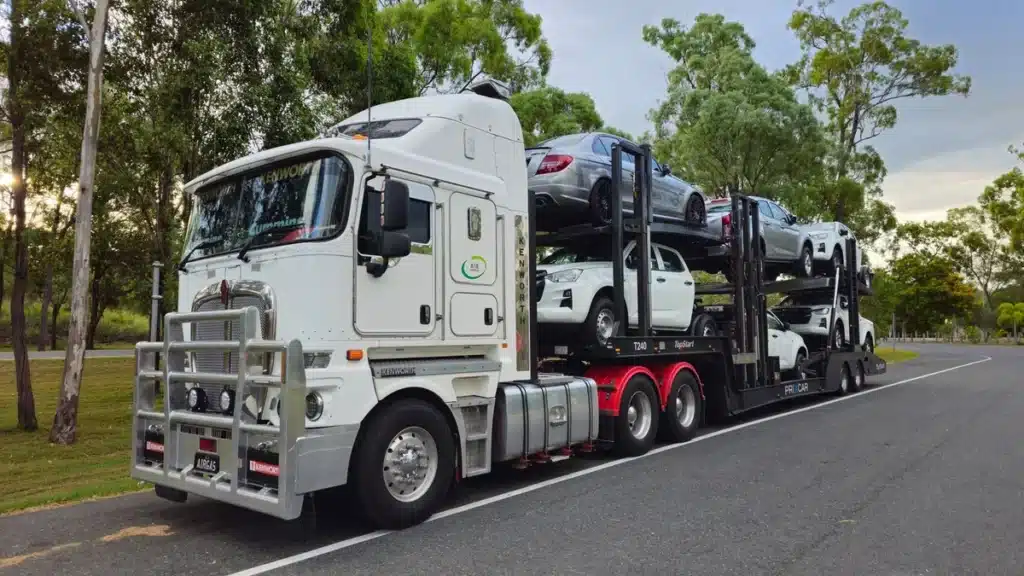
At a Glance
Open transport is the industry default: your vehicle rides secured on an uncovered multi-car trailer, exposed to the same weather and road conditions it would face being driven.
It is also how manufacturers move new inventory to dealerships, which is the most useful fact about it. Our published long-haul reference rate is about $0.58 per mile on typical long-distance open routes.
What you will learn:
- How an open carrier is loaded and secured
- What exposure actually means in practice
- The specific cases where enclosed is worth the premium
Written by Daniela Quinchia —
Reviewed by
Last updated: 20 September 2026. This guide follows our editorial policy: every figure is either sourced to a named authority or flagged for verification.
What is open auto transport?
Open auto transport moves your vehicle on an uncovered multi-car trailer, secured with straps or chains, exposed to weather and road conditions for the length of the trip.
It is the method you already recognise: the two-deck car hauler on the interstate carrying eight or ten vehicles. It is also, and this is the part worth internalising, how manufacturers deliver brand-new cars to dealerships. If it were meaningfully risky, that is not how a new vehicle would reach the showroom floor.
The economics are simple. More vehicles per trailer means the cost of the truck, the fuel and the driver is divided across more customers. That is why open is the cheapest method and always will be.
How the vehicle is loaded and secured
Loading is a sequence, not an improvisation, and the order is driven by weight distribution and the driver’s delivery route.
What happens at pickup:
- Condition inspection. The driver walks the vehicle and records existing damage on the Bill of Lading. You sign that it is accurate.
- Positioning. Heavier vehicles generally go low and forward. Your car’s slot depends on the whole load, not preference.
- Securing. Wheel straps or chains at the suspension or frame points, depending on equipment.
- Documentation. You receive a copy of the Bill of Lading. Keep it; it is the reference document at delivery.
At delivery the same inspection runs in reverse, comparing against the pickup record. That comparison is the entire basis of any damage claim, which is why the pickup inspection deserves your attention.
What exposure actually means
Exposure means weather and road debris, not neglect. Being precise about this matters, because vague fear of open transport leads people to pay for enclosed they do not need.
What your vehicle is genuinely exposed to:
- Rain, sun and road dust. The car arrives dirty. This is normal and is not damage.
- Road debris. Stones kicked up by traffic, exactly as when driving. This is the real risk, and it is small.
- Weather in transit. Hail is the uncommon worst case.
What it is not exposed to: being driven, being loaded carelessly, or sitting unsecured. Those are handling questions, and they are governed by the carrier’s practices and insurance, not by whether the trailer has a roof.
Who open transport suits
Open transport is correct for the large majority of vehicles that move in this country.
| Vehicle | Open transport fit |
|---|---|
| Daily drivers, family sedans and SUVs | Ideal. No reason to pay more. |
| Pickup trucks with standard ride height | Ideal, though size affects pricing. |
| New or near-new vehicles | Appropriate. This is how dealers receive them. |
| Classic and collector cars | Consider enclosed. Paint and originality carry value. |
| Exotic and low-clearance vehicles | Enclosed. Loading angles alone justify it. |
| Freshly restored or show vehicles | Enclosed. |
The deciding question is not whether damage is possible. It is whether a stone chip on this specific vehicle would be a loss you would feel.
Insurance, liability and the Bill of Lading
The Bill of Lading is the document that matters, and most people sign it without reading it.
Every carrier hauling in our network is required to hold valid cargo insurance before it qualifies. That coverage sits with the carrier, and the condition record on the Bill of Lading is what any claim is measured against.
What to do at both ends:
- Photograph the vehicle from every angle before loading, with a timestamp. Include wheels, bumpers and the roof.
- Read the pickup inspection notes before you sign, and correct anything inaccurate on the spot.
- Inspect before signing at delivery. Wash off dust if needed. Once you sign clean, a later claim is much harder.
- Note anything new on the delivery copy before the driver leaves.
Brokers arranging the move carry their own federal obligation: $75,000 in financial security under 49 CFR 387.307, filed with FMCSA and publicly verifiable.
Booking an open transport that goes smoothly
Most problems on open transport trace to information not shared at booking.
- Declare modifications. Lift kits, roof racks, oversized tires and spoilers change which trailer slots work.
- Declare running condition honestly. A non-running car needs a winch-equipped carrier.
- Give a flexible pickup window. Two or three days matches far faster than a fixed date.
- Empty the vehicle. Carriers generally do not accept liability for personal items.
- Leave about a quarter tank of fuel. Enough to load and unload, not enough to add unnecessary weight.
Our full preparation checklist covers the rest.
Explore the full transport toolkit
- Open auto transport — The default method and what it covers.
- Door-to-door car shipping — How pickup and delivery actually work.
- Expedited car shipping — When paying for priority is justified.
- How much does car shipping cost — Every factor that moves the number.
- How long auto transport takes — Realistic transit windows by route type.
- How to prepare a car for transport — Pre-pickup checklist.
- Shipping an inoperable vehicle — What changes when the car does not run.
- Spotting transport scams — Verify a broker before you pay anything.
Frequently asked questions
Is open auto transport safe for my car?
Yes for the overwhelming majority of vehicles. It is the method manufacturers use to deliver new inventory to dealerships. The vehicle is strapped down and exposed to weather and road debris, the same conditions it faces being driven.
Will my car get dirty on an open carrier?
Usually yes. Road dust and rain are normal on an open trailer, and a dirty car on arrival is not damage. Inspect for dents, chips and fluid leaks rather than judging by surface dirt.
Can my car be damaged on an open trailer?
Damage is uncommon but possible, most often from road debris. Every carrier in our network is required to hold valid cargo insurance before it can haul, and you document condition at both ends on the Bill of Lading.
How many cars are on an open carrier?
A full-size open carrier typically holds several vehicles across two decks. That shared capacity is exactly why open transport costs less per vehicle than enclosed.
Should I choose enclosed instead?
Only if road exposure would be a meaningful loss on that specific vehicle – classic, exotic, low-clearance or freshly restored. For a daily driver the premium buys protection you do not need.
Can I ship a non-running car on an open carrier?
Yes, but the carrier needs a winch and the load has to be declared as inoperable when you book. Rolling, steering and braking status all affect which trucks can take it.
Key takeaways
- Open transport is the default for a reason – lowest cost, widest availability, and how new cars reach dealerships.
- Exposure means weather and road debris, the same conditions the car faces being driven.
- Upgrade to enclosed only when a stone chip would be a real loss, not as a general precaution.
Get your open transport quote — or see our open auto transport service details.
References
- Broker Registration. Federal Motor Carrier Safety Administration.
- 49 CFR 387.307 – Property broker surety bond or trust fund. Electronic Code of Federal Regulations.
- Hours of Service Regulations. Federal Motor Carrier Safety Administration.
Featured image: Elite Transport Solutions on Pexels.