
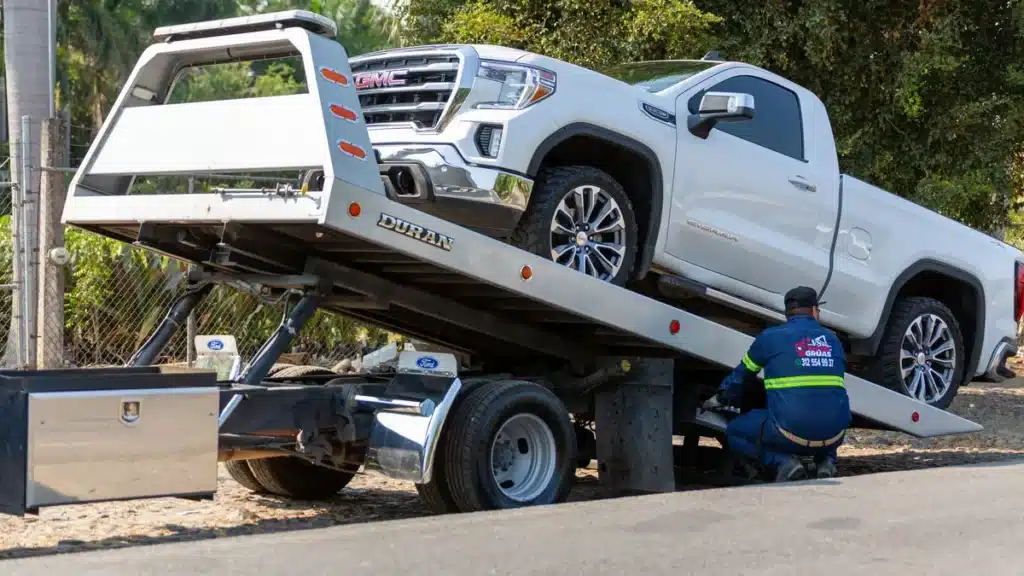
At a Glance
Yes, non-running vehicles ship routinely – but ‘does not run’ is not enough information. The carrier needs to know three separate things: whether it rolls, whether it steers, and whether it brakes.
Those three answers determine the equipment required, which determines which carriers can accept the load and what it costs. A vehicle that rolls and steers is a straightforward winch load. One that does neither needs a forklift or a flatbed.
What you will learn:
- The three questions that define an inoperable load
- What equipment each answer requires
- How to declare it so the driver arrives prepared
Written by Daniela Quinchia —
Reviewed by
Last updated: 20 September 2026. This guide follows our editorial policy: every figure is either sourced to a named authority or flagged for verification.
Can you ship an inoperable vehicle?
Yes. Non-running vehicles move every day — auction purchases, project cars, insurance write-offs and vehicles that failed on the way to somewhere.
What matters is not whether it runs. It is what it can still physically do. Dispatch needs three answers, and “it doesn’t run” gives none of them.
Get those three right at booking and the shipment is routine. Get them wrong and the driver arrives with the wrong equipment, refuses the load, and you start again.
The three questions that define the load
Rolls, steers, brakes. Answer each one separately and honestly.
| Question | What it means | If the answer is no |
|---|---|---|
| Does it roll? | Wheels turn freely, nothing seized, transmission not locked | Needs a forklift, dollies or a flatbed. Cannot be winched conventionally. |
| Does it steer? | Front wheels can be directed while being pulled | Cannot be guided onto the trailer. Needs dollies or specialist handling. |
| Does it brake? | Can be stopped and held on the deck | Loading becomes higher risk and the securing plan changes. |
A vehicle that rolls, steers and brakes but will not start is the easiest case by a wide margin. It winches on like a running car that simply does not start.
What equipment each case requires
The equipment follows directly from the three answers, and equipment is what shrinks the carrier pool.
- Rolls, steers, brakes — no start. Winch-equipped carrier. Widest availability of the non-running cases.
- Rolls and steers, no brakes. Winch plus a careful securing plan on the deck.
- Rolls, does not steer. Dollies under the front, or a flatbed.
- Does not roll. Forklift or flatbed with a liftgate. Smallest pool, highest cost.
Keys matter too. Without keys the steering column may be locked, which can turn a rolling vehicle into a non-steering one. Mention keys explicitly.
What it costs and why
Non-running loads carry a surcharge, and it is not arbitrary.
Three real costs sit behind it:
- Equipment. A winch-equipped or liftgate carrier is a more expensive truck.
- Time. Winching a vehicle takes substantially longer than driving one up a ramp, at both ends.
- Scarcity. Fewer carriers can take the load, which reduces competition on the lane.
Our guide on what determines car shipping cost covers how equipment needs feed into any quote.
Preparing a non-running vehicle
Preparation matters more here, because the vehicle cannot be repositioned once it is on the deck.
- Clear access. The carrier needs room to winch in a straight line. A car wedged in a garage or behind other vehicles is a problem.
- Note loose or damaged body panels. Parts that could detach during winching need securing or removing.
- Provide keys if they exist, even if the vehicle will not start.
- Check tire condition. A flat tire turns a rolling vehicle into a non-rolling one.
- Photograph thoroughly. Existing damage on a non-running car is often extensive, and documenting it protects both sides.
- Empty the vehicle as you would any shipment.
Declaring it properly at booking
The failure mode here is always the same: the vehicle was described as “not running” and the driver arrived without a winch.
What to tell dispatch:
- The three answers — rolls, steers, brakes, each yes or no.
- Whether you have keys.
- What is wrong with it, in plain terms. Dead battery is different from seized engine.
- Where it is sitting and how accessible that is for a winch line.
- Any structural damage that affects how it can be pulled.
Book with more lead time than you would for a running vehicle. The smaller carrier pool means matching takes longer, as covered in how long auto transport takes.
Explore the full preparation toolkit
- How to prepare a car for transport — The pre-pickup checklist.
- Shipping an inoperable vehicle — What changes when the car does not run.
- Door-to-door car shipping — How pickup and delivery actually work.
- How much does car shipping cost — Every factor that moves the number.
- How long auto transport takes — Realistic transit windows.
- Open auto transport — The default method explained.
- Spotting transport scams — Verify a broker before you pay.
- Auto transport FAQs — The questions we get most.
Frequently asked questions
Can you ship a car that does not run?
Yes. Non-running vehicles ship routinely on winch-equipped carriers. What matters is whether the vehicle rolls, steers and brakes, because those three answers determine the equipment needed and which carriers can accept it.
How much more does it cost to ship a non-running car?
There is a surcharge, because the load needs specific equipment and takes longer to handle. The exact amount depends on the vehicle’s condition and the route.
What does rolls, steers and brakes mean?
Three separate capabilities. Rolls means the wheels turn freely and it is not seized or locked. Steers means the wheels can be directed while being pulled. Brakes means it can be stopped on the trailer. Each one missing narrows the equipment options.
Can you ship a car with no keys?
Often yes, but say so at booking. Without keys the steering may be locked, which changes the vehicle from a winch load to a forklift or dolly load and affects which carriers can take it.
Can you ship a wrecked or flood-damaged car?
Usually yes. Salvage and wrecked vehicles are routine freight for the right equipment. Describe the damage honestly, including whether the body is intact enough to be winched without collapsing.
What if my car becomes inoperable after I book it?
Tell dispatch immediately. A carrier assigned to a running vehicle may not have a winch, and a surprise at pickup usually means the load is refused and rebooked – costing you a cycle.
Key takeaways
- Rolls, steers, brakes – answer all three. ‘Does not run’ tells dispatch almost nothing.
- Declare it at booking, not at pickup. A driver without a winch cannot take the load.
- Expect a surcharge and a smaller carrier pool. Book with more lead time than a running vehicle.
Get your non-running quote — or see our door-to-door car shipping service details.
References
- Broker Registration. Federal Motor Carrier Safety Administration.
- 49 CFR 387.307 – Property broker surety bond or trust fund. Electronic Code of Federal Regulations.
Featured image: Jonathan Reynaga on Pexels.