
At a Glance
Shipping a vehicle to Hawaii means choosing the right harbor for your island, then clearing a registration clock that starts the day the car lands.
The Hawaii Department of Transportation Harbors Division operates nine commercial harbors across the islands — Honolulu, Kalaeloa Barbers Point, Hilo, Kawaihae, Kahului, Kaunakakai, Kaumalapau, Nawiliwili and Port Allen (Hawaii DOT Harbors). Which one serves you depends entirely on which island you are moving to.
What you will learn:
- Which harbor serves each Hawaiian island
- Why your car is designed to fail its first safety inspection
- The 30-day clock that starts the moment the vehicle arrives
Written by Daniela Quinchia —
Reviewed by
Last updated: 20 September 2026. This guide follows our editorial policy: every figure is either sourced to a named authority or flagged for verification.
What is Hawaii vehicle port shipping?
Hawaii vehicle port shipping is the ocean movement of a car between a mainland U.S. port and one of Hawaii’s commercial harbors, followed by a state registration process with a hard deadline. Like Puerto Rico, this is domestic commerce rather than an international export — but unlike a mainland move, it runs on published vessel schedules and ends with a compliance step you cannot skip.
Two things distinguish Hawaii from every mainland route. First, the destination harbor is determined by your island, not by your address, and not every island is served the same way. Second, the state has a registration window that begins on arrival, and meeting it requires a safety inspection sequence that surprises almost every first-time shipper.
Get those two right and the move is routine. Miss either and you are looking at either a missed sailing or a compliance problem after the car has already landed.
If you are comparing island routes, the Caribbean equivalent runs on entirely different tax rules — see our guide to car shipping to Puerto Rico.
Start with the harbor, because everything else follows from it.
The nine harbors and which island each serves
Hawaii DOT’s Harbors Division plans, operates and maintains nine commercial harbors, and each island is served by a specific facility. Honolulu Harbor on Oahu is the primary gateway, but it is not the only one, and shipping to a neighbor island does not necessarily mean routing through Oahu on your own.
| Island | Commercial harbor |
|---|---|
| Oahu | Honolulu Harbor; Kalaeloa Barbers Point Harbor |
| Hawaii (Big Island) | Hilo Harbor; Kawaihae Harbor |
| Maui | Kahului Harbor |
| Molokai | Kaunakakai Harbor |
| Lanai | Kaumalapau Harbor |
| Kauai | Nawiliwili Harbor; Port Allen |
Source: Hawaii Department of Transportation, Harbors Division.
The practical consequence is that a Maui move and an Oahu move are different shipments with different schedules, even when they originate from the same mainland port. Hawaii DOT publishes daily shipping schedules for its harbors, which is a useful sanity check on any timeline you are quoted.
Harbor operations themselves are governed by state administrative rules under Title 19, including Chapter 19-43 on motor vehicles and Chapter 19-44 on services, charges and fees.
Before any of that, the same federal statute that shapes Puerto Rico shapes this lane.
Why the Jones Act applies here too
Hawaii is a U.S. state, so cargo moving between the mainland and the islands is coastwise trade and must travel on Jones Act qualifying vessels. Those vessels must be U.S.-built, U.S.-owned and U.S.-crewed under 46 U.S.C. § 55102.
The Congressional Research Service’s background on the statute explains that the requirement traces to Section 27 of the Merchant Marine Act of 1920 and applies to merchandise carried between U.S. points (CRS R45725). Your vehicle is merchandise for these purposes.
What that means for planning:
- You are booking a sailing, not a truck. Cutoffs are fixed and published.
- Missing a cutoff costs a cycle, not an afternoon. On neighbor-island service especially, sailings are less frequent than Oahu.
- Inland trucking is a separate leg. A delay reaching the mainland port cascades into the ocean schedule.
U.S. Customs and Border Protection administers the coastwise laws and publishes its interpretation in a dedicated compliance guide (CBP, The Jones Act). You file nothing yourself, but the carrier’s compliance is what makes the booking valid.
With the vessel settled, the paperwork determines whether the car actually makes it aboard.
Documents you need at the terminal
Terminal staff check documents before the vehicle is accepted, and a mismatch means the car does not sail. The Hawaii list is slightly different from a mainland handover because the bill of lading later becomes part of your registration file.
Assemble these and make sure the names agree across all of them:
- Current out-of-state vehicle registration.
- Title, or the lienholder’s name and address if the vehicle is financed.
- Government-issued photo identification matching the registration.
- Bill of lading showing the VIN — issued at the origin terminal and needed again later.
- Lienholder authorization if you do not hold the title outright.
Keep the bill of lading. County registration offices ask for shipping documents showing the VIN as proof of when and how the vehicle arrived, so the piece of paper you collect at the mainland terminal is the same one you present in Hawaii weeks later.
Physical preparation matters too — our guide on how to prepare a car for transport covers the condition standards terminals apply.
Once the car lands, the sequence takes a turn that catches nearly everyone.
The safety inspection that fails on purpose
Your vehicle is supposed to fail its first Hawaii safety inspection, and that failure certificate is a required document, not a problem to fix. This is the single most counterintuitive step in the entire process.
Here is the logic. Hawaii safety inspection stations check, among other items, whether the vehicle carries valid registration in the county. A newly arrived mainland vehicle does not. So even a mechanically perfect car fails that line item — and the City and County of Honolulu’s own guidance describes exactly this: if the vehicle passes all other items, it will fail on valid registration (Honolulu Department of Customer Services).
You then use that failed certificate as part of your out-of-state permit application. The sequence runs:
- Take the vehicle to an official Hawaii Safety Inspection Station.
- Receive the failed certificate (failed on registration only).
- Apply for the out-of-state permit or Hawaii registration using that certificate plus your shipping documents.
- Return to the inspection station to pass and receive the valid emblem.
Important caveat: that only holds if registration is the sole failure. If the inspection finds genuine mechanical defects, those must be corrected before you can register. A car that needed brake work on the mainland still needs brake work in Honolulu.
One more clock applies to that final step: you return to the station within 30 days of the original failed safety check to pass and collect your emblem.
The 30-day registration clock
You have 30 days from the vehicle’s arrival to obtain either an out-of-state permit or a Hawaii vehicle registration. The clock starts on arrival, not on the day you get around to it.
The City and County of Honolulu states the requirement directly for Oahu: within 30 days of the vehicle’s arrival, the vehicle must obtain either an out-of-state permit or a Hawaii registration (Honolulu Department of Customer Services). Neighbor islands administer their own registration through their county offices — Hawaii County and Maui County publish their own out-of-state permit procedures.
The out-of-state permit exists for people who want to keep their mainland plates, typically because the stay is temporary. For Honolulu it requires a valid out-of-state registration, the title or lienholder address, shipping documents with the VIN, the application form, and the failed safety inspection certificate.
Two practical points:
- Registration is administered at county level, not state level. Confirm requirements with the county you are actually moving to.
- The permit is not permanent. If you stay, you will eventually convert to Hawaii registration.
Moving a car between islands has its own considerations.
Inter-island vehicle moves
Moving a vehicle from one Hawaiian island to another is still an ocean shipment, with its own booking, its own sailing and its own harbor pair. The distances look small on a map, but there is no bridge and no ferry network carrying vehicles between all islands.
Because the harbors differ by island, an inter-island move is defined by the pair — Kahului to Hilo is a different service from Honolulu to Nawiliwili. Neighbor-island harbors such as Kaunakakai on Molokai and Kaumalapau on Lanai handle substantially lower volumes than Honolulu, which affects how often service runs.
The registration advantage is that a vehicle already registered in Hawaii does not restart the arrival clock in the way a mainland import does. The logistical disadvantage is that fewer sailings mean less flexibility if you miss a cutoff.
Whichever direction you are moving, the same preparation rules apply.
Best practices before you book
The Hawaii moves that go smoothly are the ones where the harbor, the paperwork and the inspection sequence were understood before the car left the mainland.
- Confirm which harbor serves your island. It determines schedule, not just destination.
- Keep the bill of lading somewhere safe. You need it again at the county office.
- Expect the first inspection to fail, and do not try to prevent it. The failed certificate is a required input.
- Fix real mechanical defects before shipping. A genuine failure blocks registration and is more expensive to resolve in Hawaii.
- Start the 30-day clock deliberately. Know your arrival date and book the inspection promptly.
- Verify your broker’s federal authority before paying. Our guide on the top signs of transport scams explains how.
- Remove personal belongings. Terminals generally will not accept liability for them.
Done in that order, a Hawaii vehicle move is a scheduling exercise rather than a scramble.
Explore the full island shipping toolkit
- Hawaii car shipping — Our service page for the Hawaii lane, including routing and booking.
- Car shipping to Puerto Rico — The Caribbean island route and its excise tax rules.
- Alaska auto transport — Barge, ferry and highway options for the far north.
- How much does car shipping cost — The cost drivers behind every route we run.
- How to prepare a car for transport — Pre-pickup checklist for any shipment.
- How long auto transport takes — Realistic timing by route type.
- Shipping an inoperable vehicle — What changes when the car does not run.
- Spotting transport scams — How to verify a broker before you pay.
Frequently asked questions
Which port do cars arrive at in Hawaii?
It depends on the island. Honolulu Harbor serves Oahu, Kahului serves Maui, Hilo and Kawaihae serve the Big Island, Nawiliwili and Port Allen serve Kauai. Hawaii DOT operates nine commercial harbors in total.
How long do I have to register my car after it arrives in Hawaii?
Thirty days from arrival. Within that window you must obtain either an out-of-state permit, which lets you keep mainland plates, or full Hawaii registration through your county office.
Why did my car fail the Hawaii safety inspection?
Most likely because it lacks valid county registration, which inspection stations check. That failure is expected for newly arrived vehicles, and the failed certificate is a required document for your out-of-state permit application.
Do I need a passport to ship a car to Hawaii?
No. Hawaii is a U.S. state, so this is domestic shipping. You need government-issued photo identification matching your vehicle registration, but no passport and no customs export filing.
Can I ship a car directly to Maui or Kauai?
Yes. Kahului Harbor serves Maui, and Nawiliwili Harbor and Port Allen serve Kauai. Neighbor-island harbors handle lower volumes than Honolulu, so sailing frequency and scheduling flexibility differ.
Can I leave belongings in my car when shipping to Hawaii?
Generally no. Ocean terminals and carriers typically prohibit personal items in shipped vehicles and will not accept liability for them. Remove everything that is not permanently installed equipment.
Key takeaways
- Nine state harbors serve the islands, and the one that applies to you is set by destination island, not by preference.
- The first safety inspection is meant to fail on registration — that certificate is an input to your permit application, not an obstacle.
- A 30-day clock starts on arrival, administered by your county rather than the state.
Request your Hawaii car shipping quote — or review our full Hawaii car shipping service details.
References
- About the Harbors Division. Hawaii Department of Transportation.
- Daily Shipping Schedules. Hawaii Department of Transportation, Harbors Division.
- Harbors Administrative Rules, Title 19. Hawaii Department of Transportation.
- Motor Vehicle Registration Information. City and County of Honolulu, Department of Customer Services.
- Out of State Permit. Hawaii County Vehicle Registration & Licensing.
- Out of State Permit. County of Maui.
- 46 U.S.C. § 55102 — Transportation of merchandise. Legal Information Institute, Cornell Law School.
- Shipping Under the Jones Act: Legislative and Regulatory Background. Congressional Research Service, Report R45725.
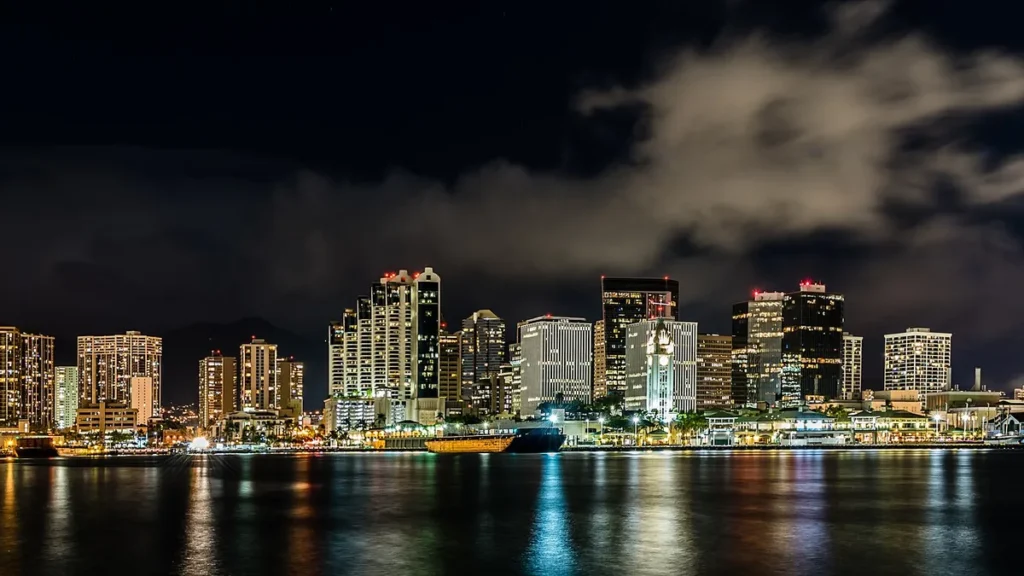
Featured image: Jason Jacobs from Honolulu, USA via Wikimedia Commons, licensed under CC BY 2.0.