
At a Glance
Car shipping is priced per mile, and the per-mile rate falls as total distance rises – which is why a 2,500-mile move costs far less than five times a 500-mile move.
Our published reference rate is about $0.58 per mile on typical long-distance routes. Fuel is the single largest input a carrier cannot control, and the U.S. Energy Information Administration publishes the national on-highway diesel average every week.
What you will learn:
- Why the per-mile rate drops as distance grows
- The seven factors that actually move your quote
- How to read a quote and spot one that will not hold
Written by Daniela Quinchia —
Reviewed by
Last updated: 20 September 2026. This guide follows our editorial policy: every figure is either sourced to a named authority or flagged for verification.
What determines car shipping cost?
Car shipping is priced per mile, and the per-mile rate falls as total distance rises. That single mechanic explains most of what confuses people about quotes. A 500-mile move and a 2,500-mile move are not priced on the same scale, because the fixed costs of dispatching a truck, loading and paperwork get spread across more miles on the longer run.
Our published reference rate is about $0.58 per mile on typical long-distance routes. That figure is a planning anchor for long hauls, not a universal multiplier — short moves price above it, and specialty equipment prices well above it.
Everything else is a modifier on top of distance: what the vehicle is, how it rides, when it moves, and whether the lane has trucks running it. The rest of this guide takes those one at a time.
If you want a number for your specific route rather than a framework, our car shipping cost calculator is the faster path.
Distance and why the rate is regressive
Longer routes cost more in total and less per mile. This is the opposite of what most people assume, and it changes how you should compare quotes.
| Distance band | Per-mile behavior | What drives it |
|---|---|---|
| Under 500 miles | Highest per mile | Dispatch, loading and paperwork spread over few miles. |
| 500 to 1,500 miles | Declining | Regional lanes with reasonable carrier density. |
| Over 1,500 miles | Lowest per mile | Long hauls amortize fixed costs best. Reference rate territory. |
The practical consequence: do not evaluate a quote by dividing it by miles and comparing across different route lengths. A $0.90 per mile short move and a $0.58 per mile cross-country move can both be fair.
Route shape matters too. Major interstate corridors between large metros carry constant truck traffic. A pickup two hours off the interstate in a low-population county does not, and pricing reflects the detour.
Fuel is the input nobody controls
Diesel is the largest variable cost in the move, and neither you nor the carrier sets its price. When fuel climbs, carrier rates follow within weeks, because a truck burning 6 to 7 miles per gallon across 2,000 miles is exposed to every cent.
The U.S. Energy Information Administration publishes the national on-highway diesel average weekly, broken out by region. If you are planning a move weeks out and want to know which direction rates are trending, that series is the honest indicator — more honest than any transport company’s marketing.
Two things follow from this:
- Quotes have a shelf life. A number from six weeks ago may not be available today, and that is not a bait tactic.
- Regional differences are real. West Coast diesel runs consistently above the national average, which shows up in lanes that originate there.
Vehicle size, weight and condition
Your vehicle is priced by the space and weight it occupies on the trailer, not by its market value. A car carrier has finite slots and a legal weight limit, and a large vehicle consumes more of both.
- Sedans and compacts are the baseline. Most pricing assumes this footprint.
- SUVs and pickups take more deck length and height, and heavier units reduce how many vehicles the carrier can load.
- Lifted, oversized or modified vehicles may not fit standard equipment at all and need a carrier with the right configuration.
- Non-running vehicles require a winch and a driver willing to handle them. Our guide on shipping an inoperable vehicle covers what the carrier needs to know.
Declaring the vehicle accurately at quote time is not a formality. A vehicle that arrives at pickup taller, longer or heavier than described can be refused by the driver, and rebooking costs a cycle.
Open versus enclosed transport
Open transport is the default and the cheaper option; enclosed exists for vehicles where road exposure is an unacceptable risk.
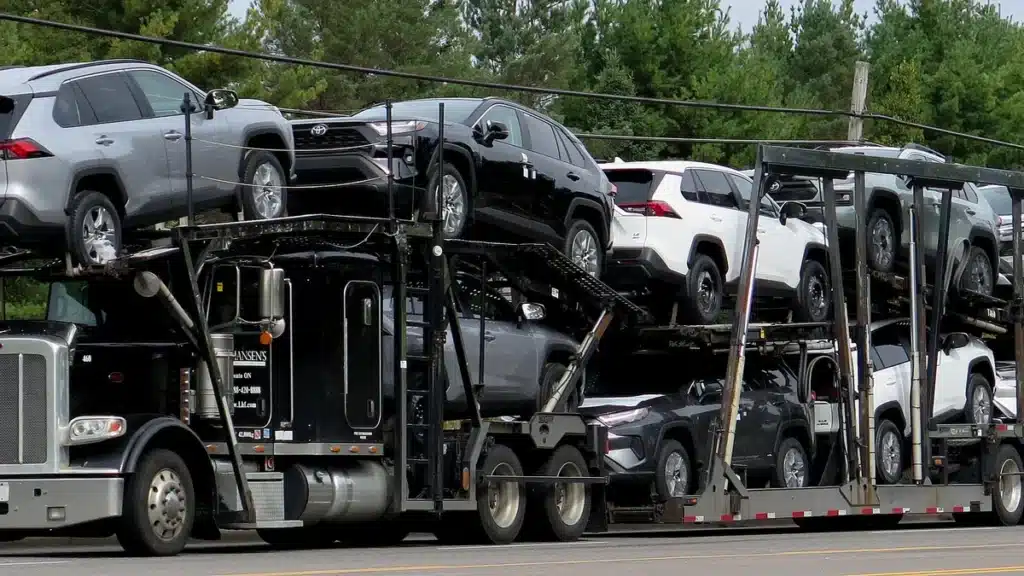
Open carriers are the multi-car haulers you see on the interstate. The vehicle is secured but exposed to weather and road debris, the same conditions it would face being driven. This is how the overwhelming majority of vehicles move, including new inventory to dealerships.
Enclosed transport puts the vehicle inside a covered trailer. It costs more because the trailer carries fewer vehicles and the equipment is more specialized. It is the right call for classic, exotic, low-clearance and freshly restored vehicles.
Our guide on open auto transport covers what the standard method actually includes.
Season, lane direction and timing
The same route can price differently in opposite directions in the same week. Carriers need loads in both directions, and an imbalanced lane means somebody pays more.
The clearest example is the snowbird pattern. Southbound traffic to Florida and the Sun Belt surges from October through December. In spring it reverses. In each peak, the heavy direction prices up and the light direction prices down.
Three timing levers that genuinely help:
- Book ahead of the peak, not into it. Four to six weeks on a seasonal lane.
- Widen the pickup window. A flexible two or three-day window gets matched to a carrier faster than a fixed date.
- Avoid month-end if you can. Relocation and lease-turn volume cluster there.
Our guide on how long auto transport takes covers the timing side in more depth.
How to read a quote that will actually hold
A quote is an offer to find a carrier at that price, not a guarantee that one exists. This is the single most useful thing to understand about the industry, and it explains almost every bad experience people report.
If a broker quotes below what carriers on that lane will accept, the load sits. Nobody picks it up. The result is not a cheap shipment — it is a delay, followed by a call asking for more money.
What a quote worth trusting looks like:
- It asks the right questions first — exact ZIP codes, year, make, model, modifications, running condition.
- It states what happens if the price changes, rather than leaving it implied.
- It does not demand a large deposit before a carrier is assigned. We charge nothing until dispatch.
- The company’s federal authority is verifiable. Brokers must hold $75,000 in financial security through a surety bond or trust fund under 49 CFR 387.307, filed with FMCSA. That status is public and checkable.
Our guide on the top signs of transport scams covers verification in detail.
Explore the full cost toolkit
- Car shipping cost calculator — Estimate your route before you commit.
- Best way to ship a car across country — Choosing between open, enclosed and expedited on long hauls.
- How long auto transport takes — Realistic transit windows by route type.
- Open auto transport — The default method and what it covers.
- Door-to-door car shipping — How pickup and delivery actually work.
- Shipping an inoperable vehicle — What changes when the car does not run.
- How to prepare a car for transport — Pre-pickup checklist.
- Spotting transport scams — Verify a broker before you pay anything.
Frequently asked questions
How much does it cost to ship a car across the country?
Cross-country moves run the longest distances and therefore the lowest per-mile rates. Against our published reference rate of about $0.58 per mile, a 2,500-mile route lands well under twice the cost of a 1,000-mile one.
Is car shipping cheaper than driving?
Often, once you count fuel, lodging, meals, days of your time and wear on the vehicle. For newer or higher-value cars the comparison also has to include depreciation from the added mileage.
Why did two companies quote me very different prices?
Because one of them priced the load at a rate a carrier will actually accept, and the other did not. Quotes are offers to find a carrier, not guaranteed capacity. A low number that no driver takes becomes a delay.
Does the type of car change the price?
Yes. Height, length and weight determine how many vehicles fit on a trailer, and a large truck or SUV displaces more than one sedan slot. Non-running vehicles also need winch-equipped equipment.
When is car shipping cheapest?
Outside the seasonal peaks on your specific lane. Snowbird corridors surge southbound in autumn and northbound in spring. The same route in late summer usually finds more available capacity.
Do I pay before or after my car ships?
With us, you pay nothing until a carrier is dispatched to your pickup. Be cautious with any company asking for a large deposit before it has secured a carrier for your load.
Key takeaways
- Distance sets the base, but the per-mile rate is regressive – longer moves cost less per mile, not more.
- Season and lane direction move quotes as much as vehicle size does. Snowbird corridors reprice twice a year.
- A quote far below the market is a signal, not a bargain. It usually means no carrier will accept the load at that rate.
Get a quote for your route — or see our car shipping cost calculator service details.
References
- Gasoline and Diesel Fuel Update. U.S. Energy Information Administration.
- Weekly U.S. No 2 Diesel Retail Prices. U.S. Energy Information Administration.
- Broker Registration. Federal Motor Carrier Safety Administration.
- 49 CFR 387.307 – Property broker surety bond or trust fund. Electronic Code of Federal Regulations.
Featured image: Elise240SX via Wikimedia Commons, licensed under CC BY-SA 4.0.